


Cart
0
You may also like






Sweetness has been a constituent of human life. Starting with festive desserts to our daily tea, the majority of us use something sweet on a day-to-day basis. However, with the rise of health consciousness, an inquiry continues to emerge frequently and that is Sugar vs Honey, which is actually better?
Both sugar and honey are equal in the aspect of adding sweetness, but they do not have the same nutritional value. One is sophisticated, naked, and bare. The other is functional, natural and nutrient-rich. The key to consuming healthier calories, energy, and long-term health is to understand the sugar and honey difference and make better decisions about the items to consume and the ones to avoid.
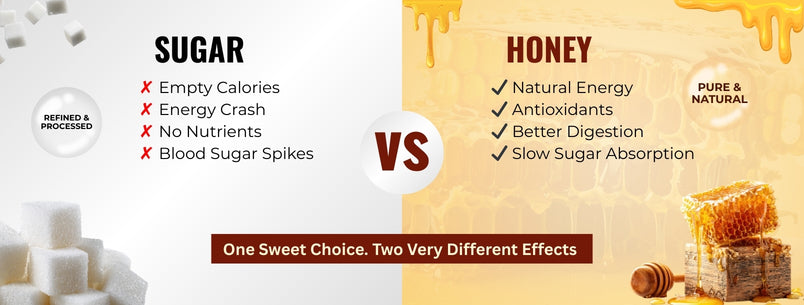
Sugar becomes white sugar and is refined after being heavily processed using sugarcane or sugar beet. During refining: The minerals and all vitamins are eliminated.
Only sucrose remains
The resultant product is empty calories.
Sugar is a quick fix of sweetness but it has no nutritional value.
Honey is a natural sugary substance, which is made by bees using flower nectar. It is low processed and has:
• Fruits (apple, pomegranate, apricot, cherry, and cherry-cherry)
• by providing substantial amounts of fructose and glucose (Cappelletti et al., 2014).<|human|>Fruits (apple, pomegranate, apricot, cherry, and cherry-cherry) through the provision of significant portions of fructose and glucose (Cappelletti et al., 2014).
• Enzymes
• Antioxidants
• Trace minerals
• Amino acids
Honey is not just a sweetener it is a functional food. Honey Sugar Content Refined Sugar. Another biggest myth is that honey and sugar are identical since they are both sweet. Honey sugar content
Honey contains:
• ~38% fructose
• ~31% glucose
• Small amounts of sucrose
• Water, enzyme, antioxidants, minerals.
• Refined sugar content
Sugar contains:
• 100% sucrose
• Zero enzymes
• Zero minerals
• Zero antioxidants
Despite the fact that honey still contains natural sugars, the composition makes its absorption slower, so the spike in blood sugar levels cannot occur when it is taken in moderation. The Nutritional Value of Honey Compared to Sugar. This is what honey can really distinguish itself with.
Honey has the following nutritional value:
• Free radical fighting antioxidants.
• Enzymes that aid digestion
• Trace minerals are potassium, calcium, magnesium and iron.
• Bacteria fighting and anti-inflammatory activity.
Sugar offers:
• Calories only
• No nutrients
• Increased inflammation
• Energy crashes
• Sugar fills the craving simply put, honey fills the body.
• Effects on Metabolism and Energy.
Sugar gives short-term burst and results in a crash. This roller-coaster effect:
• Increases hunger
• Promotes overeating
• Affects mood and focus
The slow energy release of honey is as a result of a fructose-glucose ratio. This makes it ideal for:
• Morning routines
• Pre-workout fuel
• Long-lasting stamina
• That is why more athletes and fitness lovers are willing to use honey instead of sugar.
• Sugar vs Honey to Ease the Digestive System and the Intestines.
• When taken regularly, sugar ruins intestinal bacteria and leads to inflammation.
Honey, on the other hand:
• Promotes the healthy gut microorganisms.
• Naturally has prebiotic properties.
• Calms the digestive tract.
• The honey in warm water in the morning is the old time remedy to the digestive system- something sugar can never give.
The greatest benefit of honey is that it is versatile and can be mixed with other products.
Popular honey pairing ideas:
• Honey and warm water and lemon (detox drink)
• Honey and nuts (energy & brain health)
• Honey & yogurt (probiotic breakfast)
• Honey + herbal tea (soothing + boosting of immunity)
• Honey and fruits (sweet and oats)
Sugar on the other hand is just an additive which contributes to no synergy and probably nothing positive.
Cooking and Daily Use of Honey.
• Tea/Coffee
• Sweet only
• Sweet + antioxidants
• Baking
• Structure
• Moisture + flavor
• Skincare
• Not usable
• Natural humectant
• Remedies
• None
• Cough, digestion, immunity
• Long-term health
• Negative
• Supportive (in moderation)
Honey is better to taste as well as to work, whereas sugar has a single purpose. The case of Honey Brands India: Why Quality Matters. Not all honey is equal. The quality is important when it comes to honey as an alternative to sugar. Many of the products are in the flooded market of honey brands India.
• Overheated
• Blended with sugar syrup
• Highly processed
True honey should be:
• Pure and unadulterated
• Rich in aroma and texture
• In some types its naturally slowly crystalising.
Such brands as Honey Hut are aimed at sourcing and selling original varieties of honey that do not lose their natural nutritional composition. When you select the appropriate brand, then you will get the actual benefits and not honey coated sweetness.
Honey is better than sugar although one should be moderate. Adult and children above 1 year safe.
Proper in small amounts (ask doctor) at the expense of diabetics. More suitable option of those cutting on refined sugar. Substituting sugar with honey does not imply unrestricted use of this product, but smarter sweetness. The Reason Honey is the Wiser Choice.
In the case of sugar vs honey, it is evident that there is a difference:
Sugar = empty calories
Honey = natural nourishment
Honey offers:
• Taste
• Nutrition
• Function
• Tradition
• Versatility
Sugar offers: Sweetness only
Wherever it is inevitable, at least make it worthwhile.
Honey is not a replacement of sugar, it is an improvement. A wholesome dietary supplement to boost your digestion, immunity, energy and wellbeing.
In a world that attempts to shun off refined and artificial foods, replacing sugar with honey is a minor change with a giant difference.
That is why, next time you want to be sweet, you should question yourself: Would you be receiving empty calories, or food?
Choose wisely. Choose naturally.







